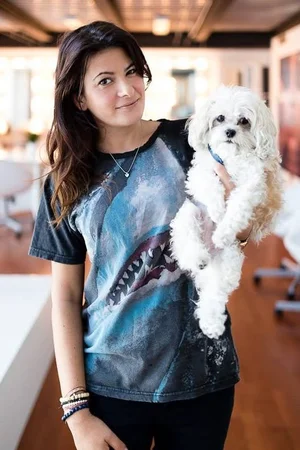

Magdalena
Wosinska
All About My Mother
Born in Poland. Moved to America in 1991. Skateboarder, guitarist, photographer. Vogue, Harley-Davidson, Joaquin Phoenix, David Lynch. None of it matters as much as the photographs of her mother in pink.
Magdalena Wosinska doesn't take photographs from a distance. She has always been inside the moment: camera on shoulder, camera in hand, present the way only someone who found belonging through a lens can be. When she moved from communist Poland to America in 1991 as a child, she found skateboarding first, then photography, then a parallel life as a guitarist in the metal band Green and Wood for eight years. They were all different versions of the same thing: a reason to be somewhere, a way to connect.
Her commercial work spans Vogue, Harley-Davidson, American Express, Wrangler, Levi's, and portraits of Joaquin Phoenix, George Clooney, Jane Goodall, David Lynch, and Alanis Morissette, among many others. She has achieved global recognition in her field. But the body of work that defines this particular conversation is more personal than any of that: her photographs of her mother.
Her mother had a stroke. Her voice became monotone, paralysis spread to one side of her face. She began to forget things in the present but remembered the past with strange clarity, fragments of childhood surfacing unbidden. And then she wrote a 76-page memoir, Childhood in Red, which Magdalena had translated into English a few months before this conversation. She intends to make a feature film from it.
 © Magdalena Wosinska
Tell us about your greatest inspirations and influences.
My mother and her acceptance and resilience in life.
How did you arrive at your photographic practice?
I grew up skateboarding. That is where I got my start in photography at the age of 14. It led to moving to California at 19 to pursue photography seriously, and a parallel life as the guitarist in a metal band, Green and Wood, for eight years. I got a lot of inspiration from touring and the music scene.
"When I moved to America, I think I found skateboarding because it was a way of finding a family to belong into. And then when I started taking pictures, it was almost like my passport to connect with people. It gave me a reason to be somewhere."
I still don't feel like I belong even though I have been here for 32 years. My personality is very different from Americans even though I have lived here my whole life, because it comes from my ancestors and from how I was raised. Photography gave me a reason to be there. A way of connecting.
Tell us about your creative process.
Each process, each shoot is different, depending on the project, whether it is for me or a client. My personal work I really sit with and almost collect images over time before I release them, if I think they are worthy in that moment.
Now it is like people just want validation with a like on Instagram and it is so sad, because that is not what it is about. I think people should just keep their head down and work hard at what they are excited about, as long as it makes them happy. Stop making things for the world to respond to. Make things for yourself to live and have emotion through.
What do you think of the art world?
I am an infant when it comes to the art world and I know nothing about it. Maybe that is a good thing.
What does wellbeing mean to you?
I have recently begun to learn how to analyse my dreams and am taking a class in self-hypnosis. It really allows me to be still and present in the moment. I also surf, hike with my dogs, and take a sauna before bed. Wellbeing is the essential foundation. Mental clarity and physical vitality together.
All About My Mother
In her own words · Photographing the person she loves mostI have been focusing on photographing my mother for the last, I don't know, half a decade. That photograph was just a moment in time in one of my visits, going back home to Arizona where I was really trying hard to pay attention about keeping my camera on me around my family, as my mother was slowly aging. I just wanted to start documenting more and more of her life and capture her beauty and her life while it is still here.
When you move out of your parents' house, you kind of move out and a phone call is enough. Seeing them on holidays is enough. And I think that was a time where I started realising how necessary it is to visit them as they are getting older. It is so special for them to see their children.
As I started photographing her, she would have these little glimpses of memories start popping up from her childhood. With certain people, when you have brain damage like a stroke, you have short-term memory loss, but you start to remember your childhood. So my mother would have these little blurbs of her memory come up from her childhood, to the point where she wrote a 76-page book called Childhood in Red that I recently had translated into English. I hope to make a feature film based off of those short stories.
During Covid, my parents got sicker. My mother was diagnosed with cancer, and we had to move them closer to family, from Phoenix, Arizona, to Denver, Colorado. In the process of moving out of our American childhood home of 30 years, we went in the attic, and I found a photo album. All of a sudden I looked at photos of her from the time she was a 14-year-old girl, to her getting her doctorate, to college, marriage, kids, losing a child, to having more kids, to immigrating and losing everything to come to America for a better life for her kids. I sat on my couch for two weeks crying, looking at these pictures of her. The soul of her is so strong and incredible.
She is funny. She had a very dry sense of humour. When she is a photo subject, she shines. She always was the centre of attention because she was a power woman. When she lost the ability with her intellect and her voice she still wore bright color pink for a reason. She wanted to be seen.
"Slowly she let me take her picture. That became a thing that was a love language between the two of us. It developed into this beautiful connection and relationship."
.
Stay curious,