Interview with Artist Hans Op de Beeck
Hans
Op de Beeck
b. 1969 · Brussels · immersive installation, sculpture, film, watercolour, theatre & opera
A Belgian maker of hushed, parallel worlds. Velvet-grey sculptures, immersive sets, films and night-painted watercolours, all suspended between the everyday and the eternal.
A practice that spans an extraordinary range.
Hans Op de Beeck produces large-scale immersive installations, sculptures, art films, watercolour paintings nearly three metres wide, and photographs. Since 2015 he has also worked in the performing arts, writing and directing theatre plays and creating their scenography and costumes. Since 2018 he has been directing opera as well, again combining it with scenography and costume design.
“At the core of everything I make is a reflection on our complex society, and the universal questions of meaning and mortality that resonate within it. I regard man as a being who stages the world around him in a tragicomic way.”
Above all, he says, he wants to stimulate the senses and invite the viewer to fully experience the parallel worlds he evokes: works that deliver a moment of wonder, silence, and soothing consolation, and that resonate with life as we know it.
“Empty sets for the viewer to walk through or sit down in. Sculpted havens for introspection.”
Why so much of the work is grey.
A large part of his sculptures, watercolours and photographs are achromic, in grey tones, black and white. The works without colour are where he loves to focus fully on the play of light and shadow, and how that gives life to a three-dimensional shape more directly. Colour, in those cases, would be a distraction.
“For some installations, and for sculptures of the human figure, I use my own specific grey, tender and velvet-like, which makes them appear frozen in time, petrified. It silences down the sculptures and creates a mood of tranquillity I hope to convey to the viewer.”
Walk us through how a work begins.
“When I create large-scale immersive installations, even when they appear dark or gloomy, my first aim is always to create a calm, silent, consoling atmosphere. I try to make the visitor as receptive as possible.”
When the viewer accepts the invitation to take time, to walk through or sit down in the space and breathe that tranquillity, he can then offer a collection of references and layers that speak about much more. He will never fully explain them. That, he feels, might harm the chemistry and inner logic of the whole. His visual fictions are meant to speak about life, actuality and history by themselves, without textual guidance.
“I prefer to abstract reality and create an evocation of mood, atmosphere, and internalised feeling. I love to evoke, not to simulate. My works are a proposal to the viewer, in the same way that fictitious characters in a novel are propositions to the reader.”
“I love to evoke, not to simulate.”
A precious Vanitas, made of small gestures.
Inspired by the painter Johannes Vermeer, the film director David Lynch and the writer Raymond Carver, Op de Beeck crafts visual fictions that offer moments of wonder and silence. Made for the Ballet de l’Opéra de Lyon’s “Danser Encore” programme, his video unveils a piece of poetic, dreamlike choreography.
The dancer Raúl Serrano Núñez, his skin and hair covered in grey and dressed in the same colour, handles mundane, colourful objects. In an instant they are turned, by the simplicity, beauty and at times endearing clumsiness of his gestures, into a precious Vanitas. With specially composed music, the video reveals the fragility of the everyday through a ballet of small hand gestures.
The watercolours are painted at night.
“My watercolours are almost three metres wide and are worked layer by layer. I paint at night, starting around eight in the evening when my assistants have left and the studio is silent. Ideally I work on a watercolour for around twelve hours straight. For most paintings I then need one or two extra nights to finish the detail.”
“The night sets the right tone. It is probably romantic nonsense, but the nocturnal mood seems to me the ultimate environment for works that, in their content, are all nocturnal.”
How those two years felt.
He remained productive, but mentally it was not easy. Just before the pandemic broke out there had been a strong sense of optimism and energy in his life. He had happily booked a spring trip to New York with his four children, and the studio was in full swing. Then the first news of victims arrived, and the restrictions with it.
During that time his eldest sister was battling cancer and was declared incurable. Because of the pandemic, only one fixed visitor, his youngest sister, was allowed to see her. Even his isolated elderly mother could not visit her own terminally ill daughter, until the very end, when his sister spent her last days in palliative care. “To lose someone that close in your life is so hard, but in the setting of the pandemic, truly even more challenging.”
Some colleagues told him the isolation was a gift for their art. For him it felt more like a numbing standstill. “My oxygen comes from the constant and parallel flowing of things, not from a sudden standstill. As an artist you choose isolation when it is welcome or necessary. Having an obliged one on top of that simply felt like too much.”
What does wellbeing mean to you?
“Wellbeing is an inner sense of simplicity, acceptance, and clarity: feeling at home with oneself, and, most of all, the absence of conflict. It means being content with life as it is. Understanding that life doesn’t need to be spectacular or rich in events, but that what is, is fine, exactly as it is.”
“What is, is fine, exactly as it is.”
Antakly Projects, originally Ninu Nina, has been in conversation with the most inspiring voices in art, photography, design and culture since 2003. Interview by Leila Antakly. Hans Op de Beeck’s parallel worlds offer exactly what he hopes for: a moment of wonder, silence, and consolation.
All works © Hans Op de Beeck. Featured work: Raul, 2022. Thank you to Hans for the conversation.
Explore the full Antakly archive →
And for the personal rants on life, opinions you didn’t ask for, and the occasional existential spiral: follow me on Substack. Follow us at @antakly.projects on Instagram.
Stay curious. ✦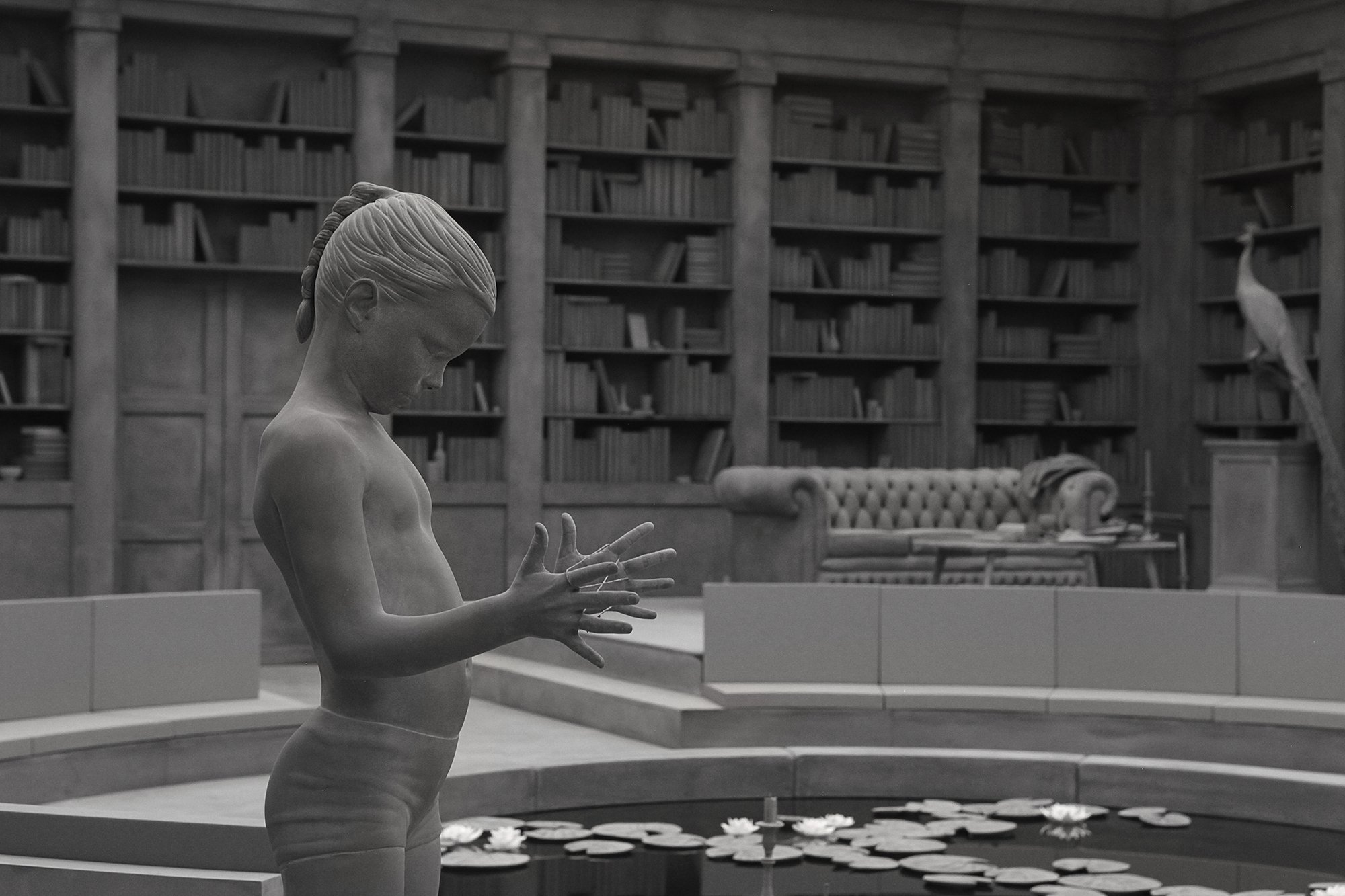
The Collector’s House, courtesy of the artist

Quiet Place, courtesy of the artist

Botsauto, courtesy of the artist

“ Location 5”