Tom Chambers Photography

Tom Chambers
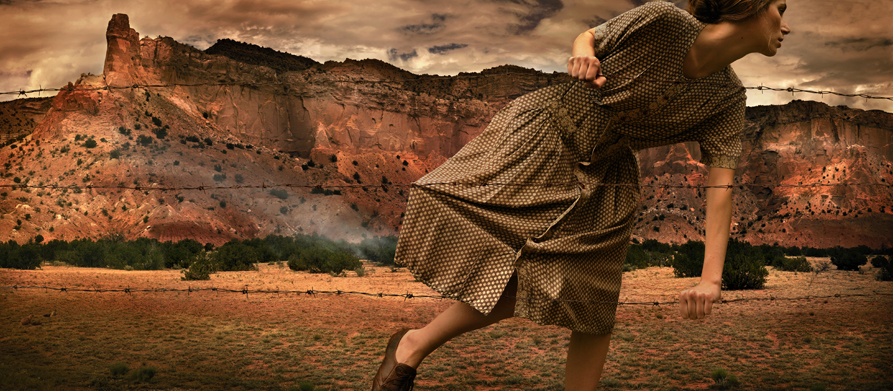
These images illustrate the fleeting moods that can't be captured by a traditional camera or seen by the naked eye.
From Amish farm country to the Ringling School to museum collections on four continents. Tom Chambers on ex votos, magic realism, and why when the viewer wonders what the hell is going on, you are holding their attention.
"More symbolic and enigmatic, less literal. When the viewer wonders what the hell is going on you are holding his attention."
Tom Chambers was raised in the Amish farm country of Lancaster, Pennsylvania. He completed a BFA from the Ringling School of Art in 1985, majoring in graphic design with an emphasis in photography. Since 1998 he has exhibited photomontage images from ten photographic series in twenty-one solo exhibitions and over seventy group exhibitions and art fairs. His work is held in collections at the National Museum of Photography in Bogota, the Santa Barbara Museum of Art, the Santa Fe Museum of Art, MOCA Bangkok, the University of Texas, and in the personal collection of Sir Richard Branson.
His book Entropic Kingdom was published by Modernbook Editions in 2012. A retrospective, Hearts and Bones, was released in 2018 by Unicorn Publishing, London. He has received fellowships from the Virginia Museum of Fine Arts and the Virginia Commission for the Arts.


What are your greatest inspirations?
As far as the subject matter, my work is influenced by Mexican religious art. I'm not a religious person in the Christian sense, but I find myself intrigued by the amount of energy people spend on grasping something which is not real or tangible not proven. I'm excited by the Mexican Indian religious art, ex votos, which are three-dimensional paintings on tin. Mexican people pray to them for miracles and healing power. Ex votos hold a sense of mystery and spiritual happening, which for me is the key, and I hope that my imagery has the same effect.
There are so many photographers out there how does one make a name for themselves?
Find out what you do well, or which genre you best fit into. Try to get onto some high-profile blog sites. Get involved. Make friends who are photographers, donate prints to charity organisations. Think nationally, not locally. When showing your work to a gallery or applying to a juried show, the first thing they look at is whether the images hold up as a group or series. The importance of this is that you have worked through the idea and pushed it to its limits. On top of that, each image has to hold its own individually. Each image, by itself devoid of the others needs to grab and hold the viewer. The more abstract you can be without losing the idea is a difficult but essential direction. When the viewer wonders what the hell is going on, you are holding their attention. A good rule of thumb: more symbolic and enigmatic, less literal.
"I find the photographs by Tom Chambers to be disgusting and offensive to man and beast alike. What a mockery of the natural order of things."
Tom Chambers' favourite response to his work
Can you explain what magic realism is?
Magic realism, or magical realism, is an artistic genre in which magical elements or illogical scenarios appear in an otherwise realistic or even "normal" setting. The dreamlike photomontages look believable but improbable. Each is carefully constructed, using both images that have been planned and those that unexpectedly enhance the story.
"With photomontage, I create ex votos that honor a deity the one for imagination."
During a trip to Mexico, Chambers was intrigued by small traditional paintings called ex votos folk art created on tin, copper or wood to illustrate occasions when a prayer was answered or a miracle occurred. They honor the power of saints. Their subjects range from common daily occurrences to truly dramatic events. Through digital photography, Chambers takes a different approach to the form. Normally photography is a method of documentation. His work is not documentation. It illustrates photographically the fleeting moods that can't be captured by a traditional camera or seen by the naked eye.
We have been a part of this change, using social media to expose the works of some of the most inspiring artists in the world and putting you, the reader, in touch with them directly. There is no need for only a few people in a flawed system to dictate what artists can and cannot be exposed to. Today it is more important than ever to preserve the artist's perspective. Because artists are. ✦